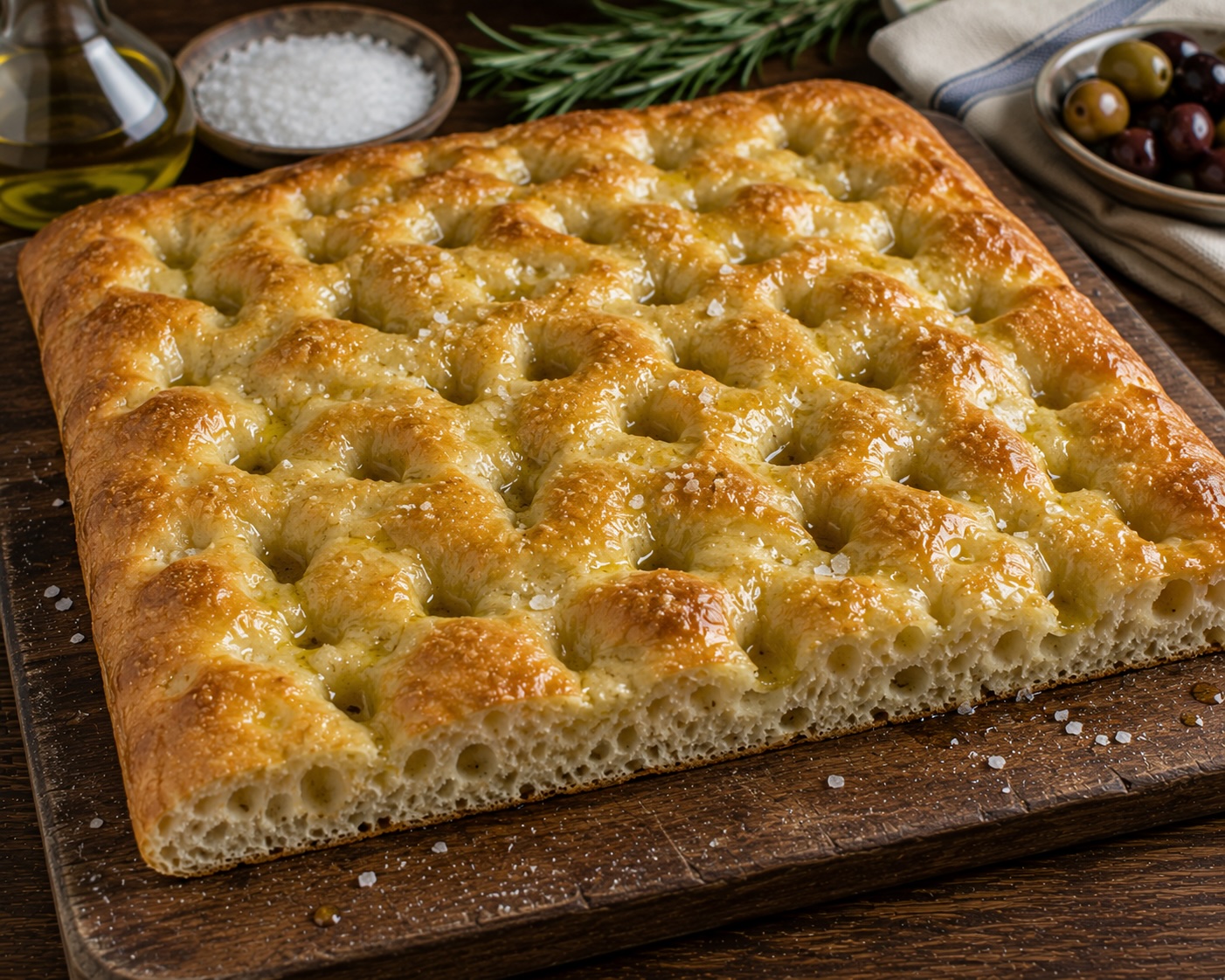
Focaccia Genovese in a Pizza Oven
Focaccia genovese — fugassa in dialect — is older than Neapolitan pizza and fundamentally different from Roman pizza bianca. It is thicker, much oilier, and made with a brine (water, salt, and olive oil) that is poured directly into every dimple before baking, pooling in each hollow and steaming the interior soft while the base crisps on the oiled tray. The three-round dimpling process — once after bulk ferment, once after pan proofing, once after adding the brine — produces a surface of ridges and pools. The ridges brown and crisp; the dimple bases stay moist. Genoese eat it plain for breakfast, dipping the corner into their cappuccino. This is not a topping-heavy recipe; the bread itself is the point.
1680 g total dough
The dough · baker’s %
- Flourstrong 00 or bread flour940 g
- Water70% hydration660 g
- Salt19 g
- Instant yeast×1.25 active-dry · ×3 fresh4.7 g
- Olive oil56 g
Bake
Place on the stone at moderate heat. The brine will sizzle in the first minutes, steaming the interior. The ridge surfaces should turn golden-brown while the dimple bases remain slightly paler and moist. Rotate halfway. Remove when the edges are golden and the base is deeply colored.
Serving
Served warm, cut into rectangles or torn. Eaten plain, with mortadella, or dipped in coffee — the Genoese breakfast habit is entirely authentic. The version with stracchino sandwiched between two paper-thin sheets (Focaccia di Recco) is a separate recipe.
Topping — scaled for 4 pizzas
- Extra virgin olive oil (dough + tray + brine combined)240 g
- Fine sea salt (for brine)40 g
- Water (for brine)320 g
- Coarse sea salt (for surface)16 g
- Fresh rosemary (optional, pressed into dimples)16 g